 Kamal Ghorui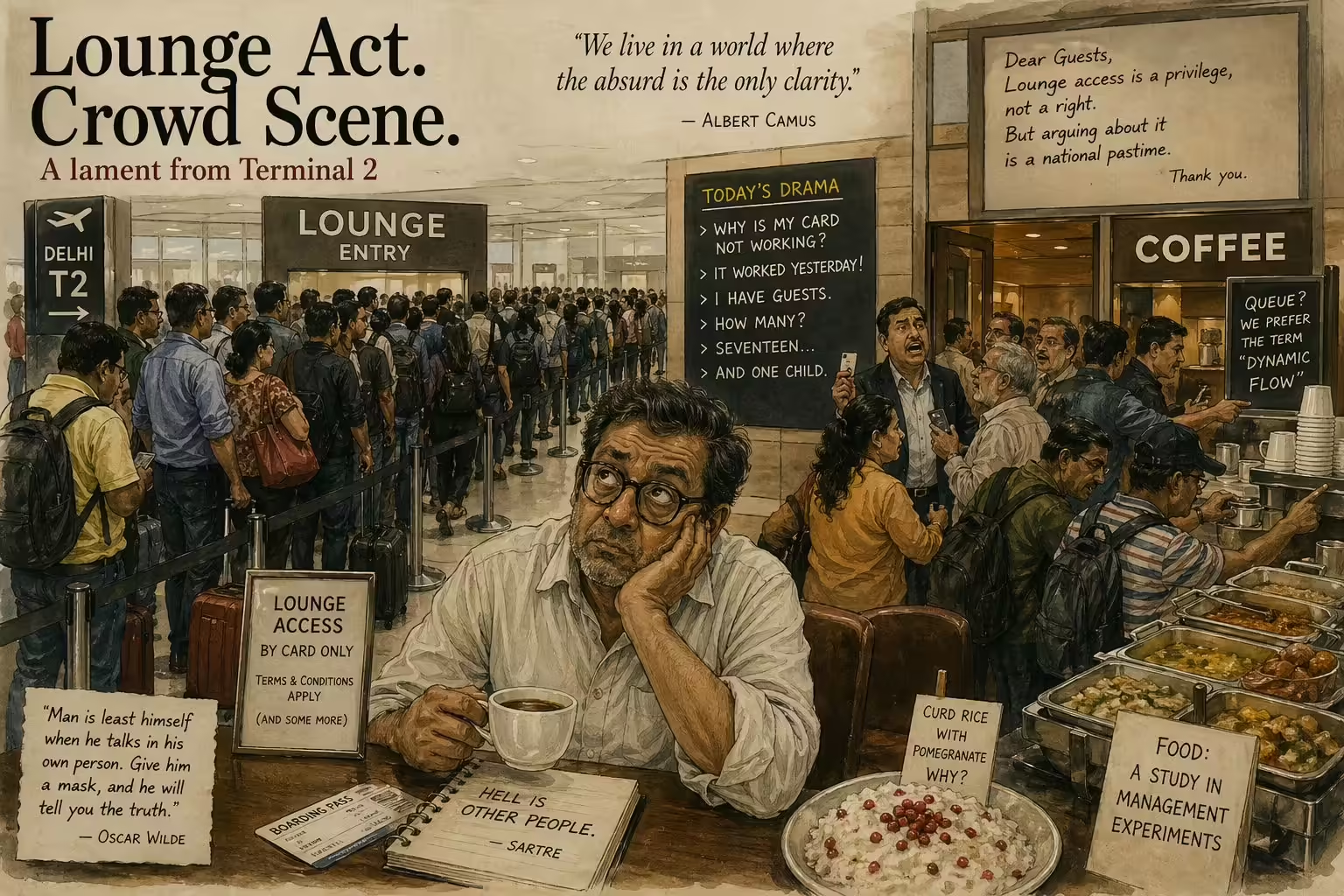
There was a time when an airport lounge did not need to announce itself. It simply existed like a well-read person in a noisy room. You entered, lowered your voice without being told to, and sat in the quiet confidence that the world, for a brief hour, would behave.
This past weekend at Indira Gandhi International Airport’s Terminal 2, the world had other plans. The line outside the lounge stretched long enough to provoke thought. Not anger but thought, because queues in India are rarely about waiting; they are about philosophy, about the delicate negotiation between patience and opportunity, about the unspoken belief that if there is a system, it exists primarily to be outwitted and skipped.
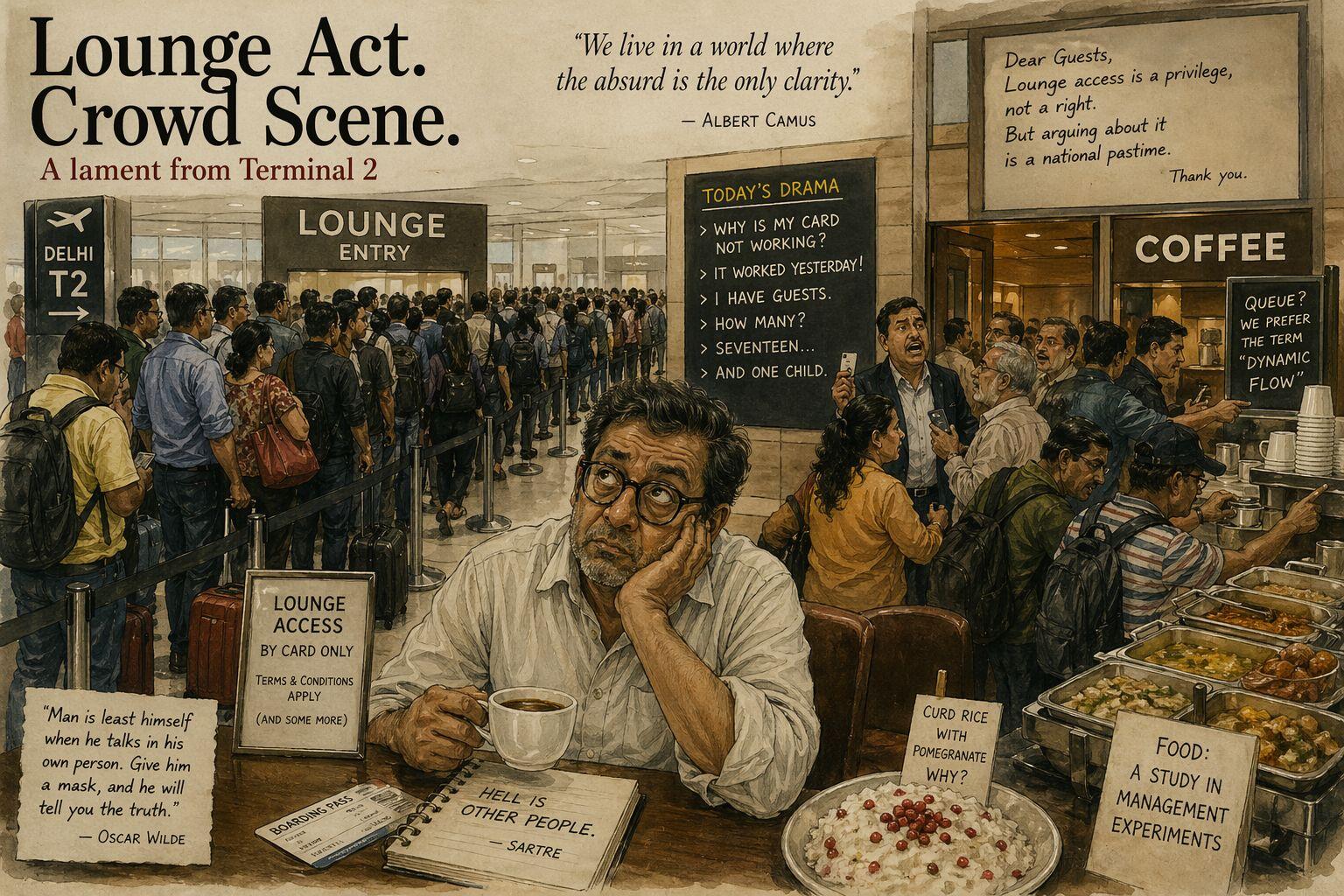

The lounge, once a refuge, now has the energy of a clearance sale.
It is the great success story of modern India. We have democratised access to privilege so efficiently that privilege itself has become indistinguishable from participation. Credit cards have done what ideology could not; they have made everyone eligible, which is a beautiful idea, until you are looking for a place to sit on a busy Friday morning at Delhi airport’s ‘Encalm’ lounge.
Inside, the choreography unfolds with remarkable consistency. You walk in with intent and slow down almost immediately. You begin to scan the room, not for comfort, but for vacancy. A chair becomes less furniture and more destiny. Eye contact acquires the sharpness of negotiation. Someone hovering is not waiting; they are planning.
“Hell is other people,” wrote Jean-Paul Sartre. He had clearly never tried to find a seat in a crowded lounge, but the sentiment holds. The coffee counter is where the idea of a line dissolves completely. There are no beginnings or endings here, only movements. A shoulder appears where there was none. A hand extends from an angle physics did not previously permit. It is less queue, more ecosystem.
And then the buffet.
The buffet has always been an act of optimism. Today, it borders on abstraction. The curd rice, which in its natural form asks for nothing more than quiet respect, has been introduced to pomegranate seeds with a conviction that suggests someone, somewhere, believes contrast is always innovation. The result is not unpleasant so much as confusing. One eats it the way one reads certain management books, with curiosity and a mild sense of astonishment and betrayal.
There is, in all of this, a larger discomfort not with the crowd (the crowd is us), but with the idea that spaces once designed for pause have now been fully absorbed into the velocity of everything else. The lounge no longer interrupts the journey. It continues it, just with softer lighting.
At the entrance, a parallel drama plays out on loop. “This card worked yesterday. Why is it not working today?”
“I have guests.”
“How many?” There is always a pause here, as if arithmetic itself is negotiable. “Seventeen.” A brief silence. “And one child.”
The staff respond with a calm that borders on spiritual discipline. Voices rise, not because anyone expects resolution, but because expression itself is the point. “We live,” wrote Albert Camus, “in a world where the absurd is the only clarity.” He might have been speaking of many things. He might just as easily have been describing a lounge access policy.
And yet, there is something reassuring about the predictability of this chaos. The way we fill every space completely, then negotiate micro-territories within it, the way we convert privilege into participation and participation into performance. You do eventually find a seat, not because the system works, but because you adapt. Someone leaves. Someone hesitates. You move. You sit. You place your bag with quiet triumph, as if you have claimed land.
The coffee, once acquired through a series of small, decisive manoeuvres, tastes exactly like it always does. Slightly burnt and very familiar. For a moment, between announcements and arguments, there is stillness.
Not the stillness the lounge was designed to provide, but the stillness you carve out of whatever you are given, which, now that one thinks of it, may have been the point all along.
END OF ARTICLE