 Kamal Ghorui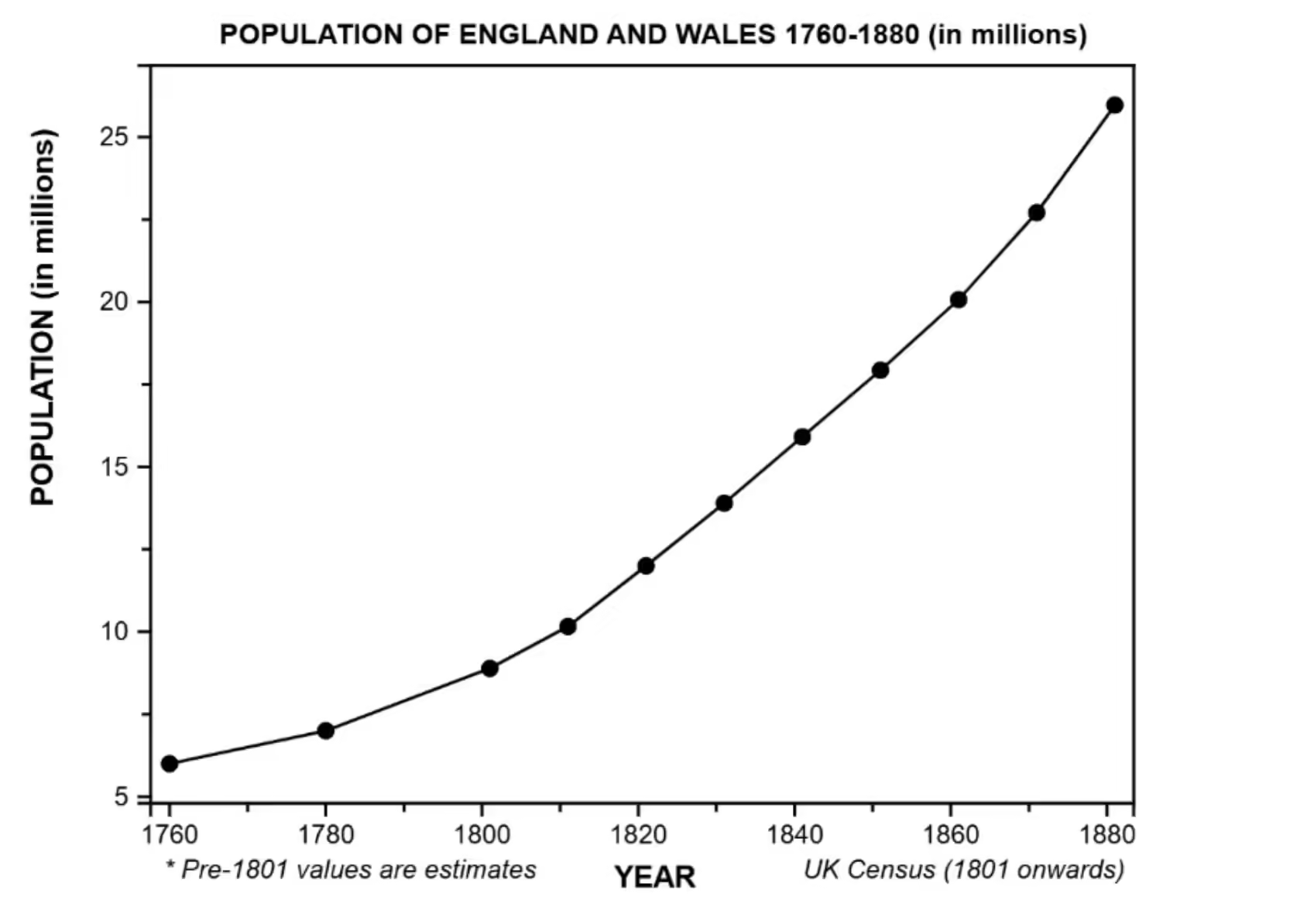
Artificial intelligence is no longer a distant ambition confined to research labs and science fiction. It is here, reshaping the rhythms of everyday life and rewriting the rules of the global economy at a pace very few anticipated. Automated systems are rapidly displacing functions once considered exclusively human, with adoption rates doubling across industries in a matter of years.
This seismic shift has been engineered, in large part, by a handful of powerful players like OpenAI, Google, Anthropic among them, whose innovations are scaling faster than the regulatory and social frameworks designed to contain them. And therein, lies an urgent, uncomfortable question that policymakers, economists, and workers can no longer afford to defer: Is the meteoric rise of AI quietly becoming the single greatest driver of structural unemployment the modern workforce has ever seen?
Simply naming this concern as “AI taking away jobs” would mean oversimplifying complex structural changes in our economy. History is a witness to the fact that rapid mechanization and technological transformation has advanced the nature of the job, and not eliminated it completely. It is irrelevant to ask if jobs were to be eliminated or not, the real question lies in the proper reorganization of work, skills, and economic opportunities in an AI-driven economy.
Technological disruption of labour has always been the core feature of economic development studies. Industrial Revolution poses a perfect example for this case study. As mechanization gained pace, livelihoods of traditional artisans and manual workers saw greater displacement and erosion. Earlier inventions like Spinning Jenny reduced the dependency on weavers and spinners to a great extent. This gave birth to social resistance from the Luddites, who protested by destroying the machines, highlighting the exploitative traits of industrial capitalism. Despite such protests, factory-based employment gained momentum. In the end, what was observable was reorganization of jobs, not its disappearance.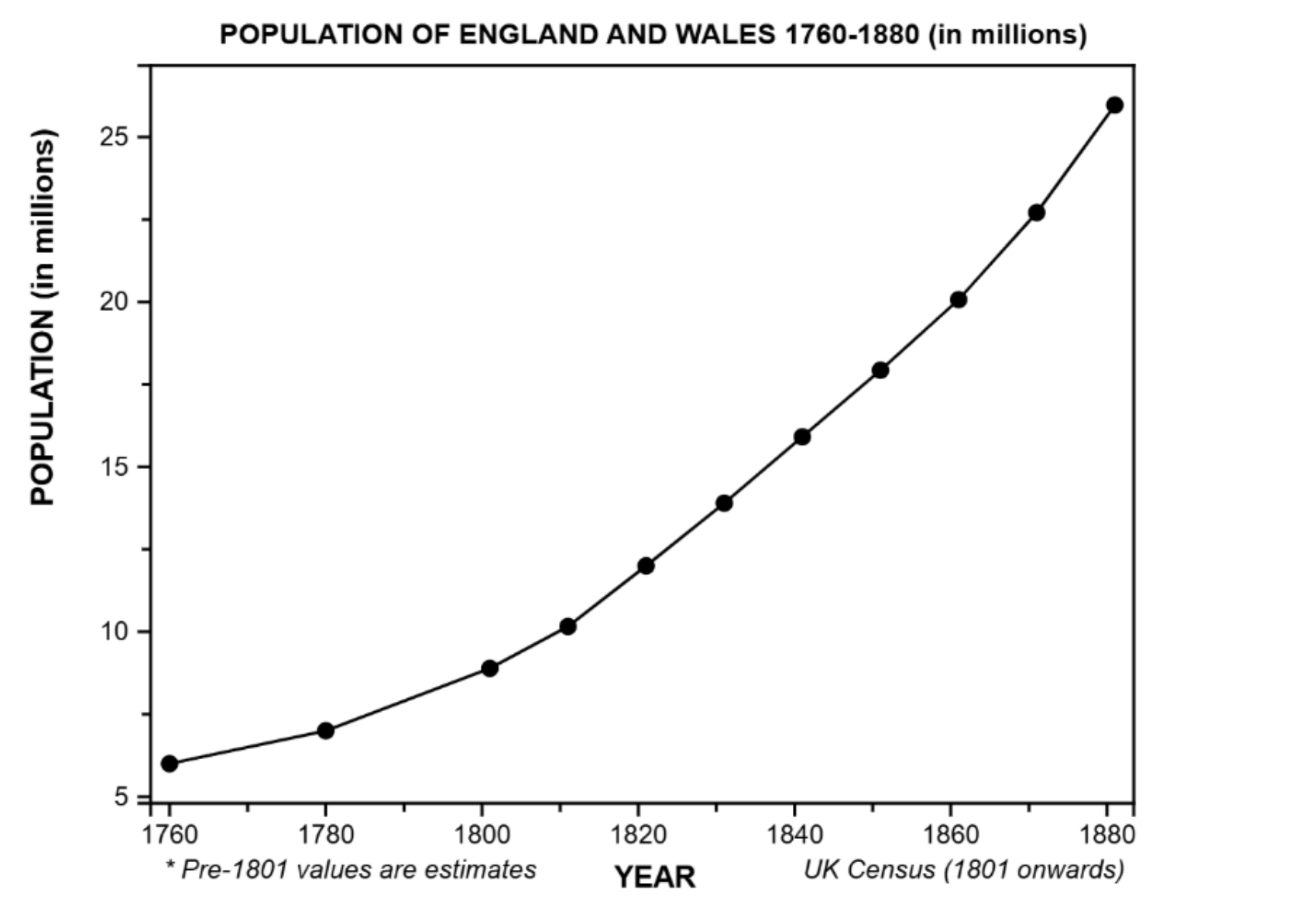

Have a look at the graph showcasing Population Growth of England and Wales (1760-1880). The direct observation which can be inferred from this data is the exponential nature of the growth curve. At the outset of the 1760s, the population was estimated to be approximately 6 million. Over the subsequent years, modest growth led to the figure reaching to 7 million by 1780. This suggests a relative gradual rate of increase in the pre-industrial era. By 1880, the population had accelerated to nearly 9 million, and this upward shift continued on a steady part through early 1880s, reaching approx. 10 million by 1811 and 12 million by 1821. Such shift in population highlights profound demographic shifts associated with Urbanization, Improving Agricultural Productivity, and Early advances in public health and medicine. Therefore, we can from this graph how rapid industrialization and population showed a cause-and-effect relationship during the 1880s.
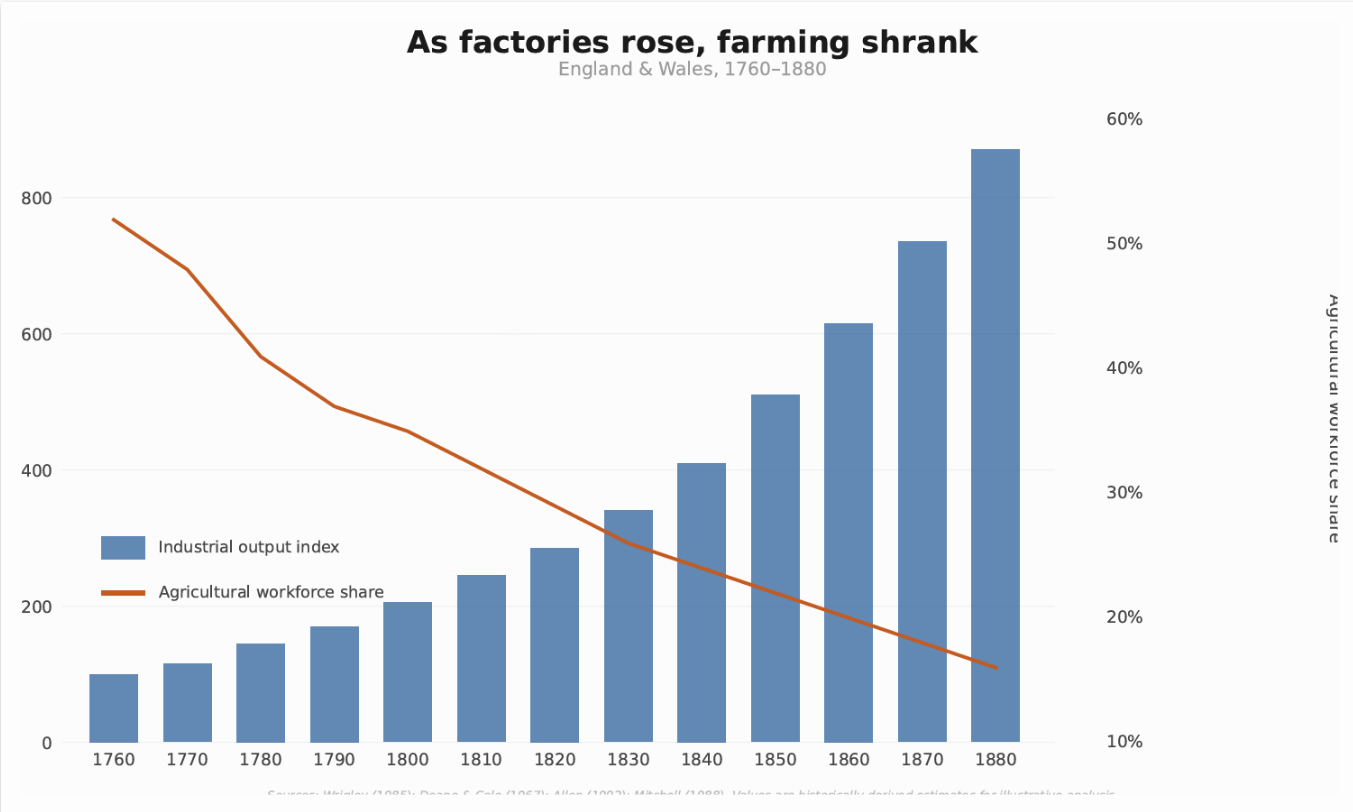

Take another look at the particular graph attested here. The graph signifies the Great Displacement, i.e. when England traded the Plough for the furnace. In 1760, more than half of the England and Wales’s working population earned their living from the land. By 1880, that share had collapsed to barely even 15 percent. In the same span of a hundred twenty years, industrial output grew nearly ninefold. The two lines moving ruthlessly in opposite directions signify what we call as the Industrial Revolution. The shift was not gradual, but more of a structural rupture.
Here, Industrial output, indexed at roughly 100 in 1760, climbed steadily through the early decades, ten accelerated sharply after 1820, also reaching close to 900 by 1880. Agriculture’s share of the workforce descended in an almost perfectly inverse arc, from above 50 percent at the revolution’s dawn to somewhere near 16 percent at its close. The symmetry is almost too clean, almost too convenient, and yet it reflects a genuine, and irreversible reordering of economic life.
What the graph cannot project, is the human texture of such reordering. Behind the falling agricultural workforce share are enclosure acts that pushed smallholders off common land they had farmed for generations. Behind the rising industrial index are mill towns like Manchester, Bradford, and Birmingham absorbing hundreds of thousands of displaced rural workers into conditions that reformers of the era described, not accurately, as organized misery. The productivity miracle and the social crisis were not separate phenomena. They were the same phenomenon, viewed from different vantage points.
We are living in exactly the same displacement of comparable magnitude, although the contours differ. AI and automation are beginning to reshape labour markets with a pace that may ultimately surpass the pace of industrialization. The agricultural workforce share that took 120 years to fall from 50 percent to 16 percent in Victorian England could find its modern analogue in white-collar and service sector employment contracting over a much shorter horizon. The mechanisms are different. The political and social stakes are strikingly similar.
The Victorian experience offers to strict lessons. Firstly, transformative economic growth and widespread human suffering are not mutually exclusive. England grew enormously wealthier between 1760 and 1880, and large portions of its population endured conditions of poverty, displacement, and social dislocation that would not be seriously ameliorated until the welfare state interventions of the following century. Growth without distribution is not stability. It is a slow accumulation of social pressure.
Secondly, the institutions that eventually managed the consequences of industrialization, labour laws, public health regulations, compulsory education, trade unions, and ultimately the welfare state, did not emerge automatically from the market. They were fought for, often bitterly, over decades. The political economy adjustment is never self-correcting. It requires deliberate, contested, and often painful institutional innovation.
Policymakers today who look at charts showing productivity gains from automation and conclude that the economics are straightforwardly positive would do well to spend some time with charts like this one. The Industrial output index of 1880 England was, by any measure, a triumph of human ingenuity and organizational capability. It was also the product of a transition that generated social trauma on a generational scale, trauma whose political consequences, including Chartism, early socialism, and the convulsions of class conflict, echoes through British politics for over a century. The furnace rose. The farm shrank. England got richer and more unequal simultaneously, and it took generations to work out what justice in an industrial society actually required.
When economists and policymakers reach for historical analogy to make sense of artificial intelligence, they inevitably invoke the argument of Industrial Revolution or the emergence of computing, which are major examples of where technology displaced workers but ultimately generated more jobs than it destroyed. The comparison is somewhat tempting, but also misleading. Equating those technological disruptions in the past with the disruptions in the present means misreading the fundamental nature of what Artificial Intelligence actually does.
The distinction lies not in scale but in architecture. Previous waves of automation were vertically targeted; they targeted specific, bounded operations, e.g. the loom replaced hand-weaving; the Excel Spreadsheet replaced a bookkeeper’s ledger. AI, by contrast, operates horizontally, cutting across entire cognitive repertoires. It merely does not replace and operation; it simply reconfigures a profession.
The cognitive reach of modern AI systems is somewhat separating this moment from anything that preceded it. Early automation was a force applied to manual and repetitive behavior. AI extends its domain into language processing, pattern recognitionsm, probabilistic reason, and decision support. A 2024 analysis by Goldman Sachs estimated that roughly 300 million full-time jobs are globally exposed to certain extent of AI Automation, with legal, financial, and administrative roles among the most vulnerable. The boundary between skilled and automatable work, long assumed to be durable, is not dissolving.
If we carefully analyze the levels of jobs which are at total risk of being disrupted by such technological transitions, occupations pertaining to standardized, rule-based tasks sit on a highest risk of automation. Such high-risk jobs involve data entry operations, basic accounting roles, tele-calling, customer support etc. Artificial Intelligence systems carry the ability to process large volumes of data with impeccable speed and accuracy, thus diminishing the demand of human labour for these jobs. The Business Process Outsourcing sector (BPO) proves to be the most vulnerable sector when comes to conversational AI increasingly replacing entry-level service roles.
In several professional occupations, Artificial Intelligence is not replacing workers per se but is limiting their capabilities. In healthcare sector, AI helps in the diagnosis and medical imaging of ailments; with reference to educational sector, it is implementing personalized learning and effective assessment; in legal firms, it is streamlining documentation reviewing and legal research. Therefore, these sectors are witnessing a greater, functional transformation in the sense where human capabilities and expertise is undermined by mechanical efficiency which, in turn, is leading to skill requirement changes instead of job rustication.
The type of jobs which remain heavily insulated are those which rely on interpersonal interaction, physical presence, contextual judgement etc. Skills like caregiving, social work, leadership roles etc. require emotional intelligence and ethical reasoning which is presently lacking in Artificial Intelligence systems. As a result, such sectors are likely to contain human centrality in its functions in the near future even if they try to integrate technological support within their ambit.
Whether automation eliminates jobs or not is a central question which is consistently sidelined by economists and policy makers. Artificial automation surely enforces that in a very systematic and selective manner. But whether the economy generates equivalent or superior employment in its wake, and whether that regeneration is distributed equitably across income classes, geographies, and skill levels is the central concern that needs addressal. With AI, there is mounting evidence that this time, the distributional answer may be grimly different.
The logic of displacement is not speculative any more. In a 2023 Goldman Sachs study, it estimated that generative AI alone could expose 300 million full-time jobs globally to some degree of automation, with legal, administrative, and financial roles carrying the sharpest vulnerability. The McKinsey Global Institute, in the same year, projected that between 75 and 375 million workers worldwide may need to switch occupational categories entirely. This range is so vast that it reflects not merely the uncertainty of AI’s reach, but the deeper uncertainty about whether institutions possess the will to respond in time.
For India, the stakes are not abstract. The country’s 5 million IT sector workers, which are the very backbone of its services-led growth story, face significant restructuring pressure from large language models now automating coding assistance, quality assurance, and basic customer operations, as NASSCOM has explicitly flagged. This is not peripheral disruption. It is pressure applied at the load-bearing column of India’s economic architecture.
What makes the current wave categorically different from prior technological disruptions is not its speed, but its selectivity. The loom, the assembly line, and the spreadsheet each concentrated displacement at the lower rungs of the wage ladder, broadly sparing and often enriching skilled cognitive labour. Research by economists Daren Acemoglu and Pascual Restrepo established that automation-driven labour displacement between 1987 and 2017 meaningfully suppressed wage growth, particularly in middle-income occupational categories. AI threatens to extend that compression upward – directly into the strata where India’s demographic dividend has historically placed its aspirations.
The inequality embedded in this transition is geographic as well as sectoral. In a 2023 report by the International Labour Organization on AI and Employment, it found out that productivity gains accrue disproportionately to capital owners and workers in high-income economies with mature digital infrastructure, while displacement costs fall asymmetrically on middle-income countries with large service-sector workforces. India fits that description with uncomfortable precision. Its gig economy – estimated at 7.7 million workers by NITI Aayog in 2022, and projected to reach 23.5 million by 2030 – illustrates the paradox starkly. Platform-based work has absorbed workers displaced from formal employment, but offers fewer protections, lower income stability, and no credible pathway to the skill upgradation the AI economy demands.
India’s policy response to this moment is not really absent. It is simply misaligned. Take an example of the e-Shram portal launched in 2021. It represents the most ambitious attempt yet to bring unorganized workers into a legible national database, i.e., over 300 million registrations, a figure that is, by any measure, an administrative achievement. But registration simply doesn’t mean protection. The portal records the existence of workers; it does not connect them to retraining pathways, income support during occupational transitions, or any mechanism that anticipates the specific sectors where AI-driven displacement is already accelerating. A database without downstream architecture is a census, not a safety net.
What India required, and does not yet have, is a Workforce Transition Framework. This is a structured obligation, backed by statute, that compels large enterprises automating functions above a defined threshold to contribute to a portable skilling fund accessible by the workers they displace. This is not a novel idea: analogues exist in the Danish flexicurity model and, in nascent form, in Singapore’s Skill Future Programme. What is exactly novel here is the urgency of India’s position. With 5 million IT sector workers facing restructuring pressure and a gig economy projected to absorb 23.5 million by 2030 – with no skilling ladder attached – the gap between displacement and transition support is not a policy oversight. It is a policy choice, and it is being made by default rather than by design.
The optimistic counterargument that AI will generate new job categories just like how previous technologies did is not entirely wrong in principle. It is, however, dangerously silent on timing. The World Economic Forum’s Future of Jobs Report 2023 projects that AI and automation will displace 85 million jobs globally by 2025 while simultaneously creating 97 million new ones. The net figure appears encouraging until one asks: who performs the new jobs, and how long does that transition actually take? The gap between displacement and regeneration is not a technical problem. It is a policy failure in the making, and the window to prevent it is narrowing.
The window for deliberate action is not permanently open. The Victorian parallel that began this essay is instructive not as consolation but as warning: England’s industrial transformation generated enormous wealth and generational suffering simultaneously, and the institutions that eventually contained that suffering arrived decades too late for those who bore its cost. India cannot afford that lag. The algorithms are already here. The regulatory architecture is not. That asymmetry is the most consequential policy failure of this decade — and closing it requires not another consultation paper, but a decision.
END OF ARTICLE