 Kamal Ghorui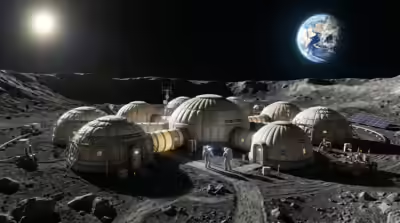
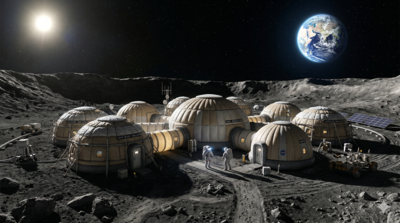
The notion of humans inhabiting the Moon has long been relegated to science fiction, but recent scientific breakthroughs indicate that it is not far-fetched to think that it will become a reality in the near future. Scientists are working hard to come up with creative ways to design lunar habitats that are light, strong, and easier to transport from Earth to the Moon. Some of the most creative ideas include designing inflatable homes, which can be easily transported to the Moon and later inflated upon arrival on the Moon’s surface. This is not only cost-effective, but it is also suitable for the harsh environment of the Moon, taking humans a step closer to living there.
What are inflatable lunar habitats
Inflatable lunar habitats are specially designed habitats made up of flexible but strong materials. These habitats can be easily transported in a compressed form and then inflated when they reach their destination. As per NASA, “inflatable habitats offer a combination of low mass and high volume efficiency, which is advantageous for space travel where mass is a major constraint.”These habitats are also provided with multiple layers to ensure safety from micrometeoroids, radiation, and temperature variations. Once inflated, these habitats can provide a platform for the astronauts to live, along with other amenities required for survival. Inflatable lunar habitats have also been found to be effective, as research in this direction has already been done by NASA in the form of their Bigelow Expandable Activity Module.
Why inflatable homes can work on the Moon
The biggest challenge when it comes to lunar exploration is the transportation of heavy building materials into space. Inflatable habitats provide a solution to this problem, as they are light and small during launch. The European Space Agency has also proposed concepts for lunar bases, including inflatable and 3D-printed habitats, which provide a clear indication of their practicality for future missions.According to experts, it is also possible to cover the habitat with lunar regolith, also known as Moon dust, once it is deployed, providing an extra layer of insulation and radiation shielding. This is a significant improvement in the safety of lunar explorers. As stated by the European Space Agency, the use of local materials is a crucial aspect of sustainable lunar living, reducing the need to rely on supplies from Earth.In addition, the inflatable habitat has the advantage of being expandable, meaning that lunar bases can expand in the future, providing a suitable solution for long-term plans for lunar habitation.
What research says about Moon living
The scientists and engineers are also researching how the human race can survive in the Moon’s extreme environment, including low gravity, radiation, and a lack of atmosphere. According to studies and mission briefings supported by NASA’s Human Exploration and Operations Mission Directorate, developing sustainable habitats is crucial for missions.Experts have pointed out, in various studies and mission briefings, the significance of closed-loop life support systems, including the recycling of air and water, as part of the habitats. Inflatable living spaces will enable astronauts to live longer on the Moon.Insights from various studies and research works suggest that the success of lunar habitats depends on the integration of engineering, biology, and environmental science. The Moon is not just the destination; it is actually the testing ground for missions to Mars and beyond.
Challenges in the new chapter and way ahead
Although the idea of inflatable homes on the Moon is promising, there are still several challenges to overcome. These challenges include protection against radiation, long-term durability, and the maintenance of pressure inside the homes. However, scientists are working hard to overcome them.With the progress of research on Design Concept and Material Characterisation, it is still clear that the idea of homes on the Moon is not impossible. Moreover, the idea of homes on the Moon is becoming a tangible idea with the help of innovative design and practical engineering that can make the first human settlements on the Moon possible with the help of inflatable homes.The idea of living in inflatable homes on the Moon is a clear example of how far space science has reached. With every step forward in space science, the idea of a lunar base becomes more and more possible. Moreover, inflatable homes are not only the result of space science, but they also show the versatility and ingenuity of the human race. However, with the efforts of space agencies and scientists to make this idea a reality, it is clear that the Moon may not be as distant in our future as we think.