 Kamal Ghorui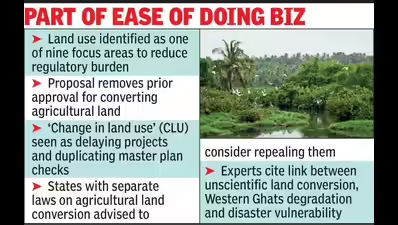
Thiruvananthapuram: The cabinet secretariat’s deregulation cell has asked states to consider scrapping the requirement for ‘change in land use’ (CLU) permissions and easing zoning norms—proposals that could have significant implications for Kerala, where land use is tightly regulated and linked to environmental safeguards.The suggestions were presented to the state govt as part of the Centre’s ‘Compliance Reduction and Deregulation: Phase II’ exercise under the ease of doing business initiative. Land use is one of nine focus areas identified for reducing what the Centre terms regulatory burden.
A key recommendation is to remove the need for landowners to obtain prior approval to convert agricultural land for non-agricultural purposes. According to the presentation, despite efforts to simplify and digitise procedures, the CLU requirement continues to delay projects and add layers of compliance. The deregulation cell argues that the financial cost of conversion is borne by landowners—often farmers—and that the permission process duplicates checks already addressed under master plans.It has therefore suggested that states with a separate law governing agricultural land conversion consider repealing it, citing Andhra Pradesh as an example. Where such provisions are part of revenue codes or tenancy laws, states may consider removing those sections. Where both exist, all provisions requiring CLU permission should be deleted.In areas covered by an approved master plan, the Centre has recommended that if a proposed activity is already permitted under the plan, no separate land conversion approval should be needed. To ensure states do not lose revenue, a fixed fee or conversion charge could still be collected without requiring a separate approval process.The deregulation cell has also proposed changes in zoning practices. It notes that many states divide land into residential, commercial and industrial zones and allocate only a small share—often 3–5%—for mixed use. Instead, it suggests a simpler approach: Allow all activities in a zone by default, except those specifically listed as prohibited.Under this ‘permitted unless prohibited’ model, each zone would have a short negative list of banned activities, with all other uses automatically allowed. A similar approach has been suggested for buildings to encourage mixed-use development.In Kerala, however, CLU intersects with a complex legal and environmental framework, including the Kerala Conservation of Paddy Land and Wetland Act, 2008, enacted to prevent large-scale conversion of paddy fields and wetlands.A senior revenue department official said the state’s context is ‘fundamentally different’ from the framework envisaged in the deregulation exercise. “In Kerala, land use cannot be viewed only from an ease-of-doing-business perspective. Wetlands and paddy fields are critical environmental resources. The state has witnessed repeated floods and landslides in recent years. There is a direct link between unscientific land conversion, degradation of the Western Ghats and disaster vulnerability,” the official said.Noted environmentalist Sridhar Radhakrishnan said Kerala cannot afford further dilution of land safeguards while it grapples with the consequences of unscientific land use. “What we need is a comprehensive land use policy grounded in sustainability and environmental science. Dismantling regulatory checks in the name of development is not the solution,” he said.