
There was a time, not very long ago, when journalism believed in the tyranny of the five questions. Who. What. When. Where. And, if the newsroom gods were feeling generous, Why. It was efficient. Respectable. Industrial. Facts were assembled, quotes inserted, headlines affixed, and the reader was informed in the manner one is informed by a railway station announcement: accurate, timely, and faintly indifferent to meaning. And then arrived the machine, calm, tireless, and offended by neither deadlines nor editors. With an almost indecent ease, it began answering the first four questions better than most of us ever could.
Who? It knows. What? It summarises. When and where? It timestamps with the confidence of a Swiss clock that has never been late. Journalism, having spent decades perfecting these questions, found itself in the awkward position of having been outperformed at its own favourite game. It is at this point that every generation reaches for a familiar consolation.
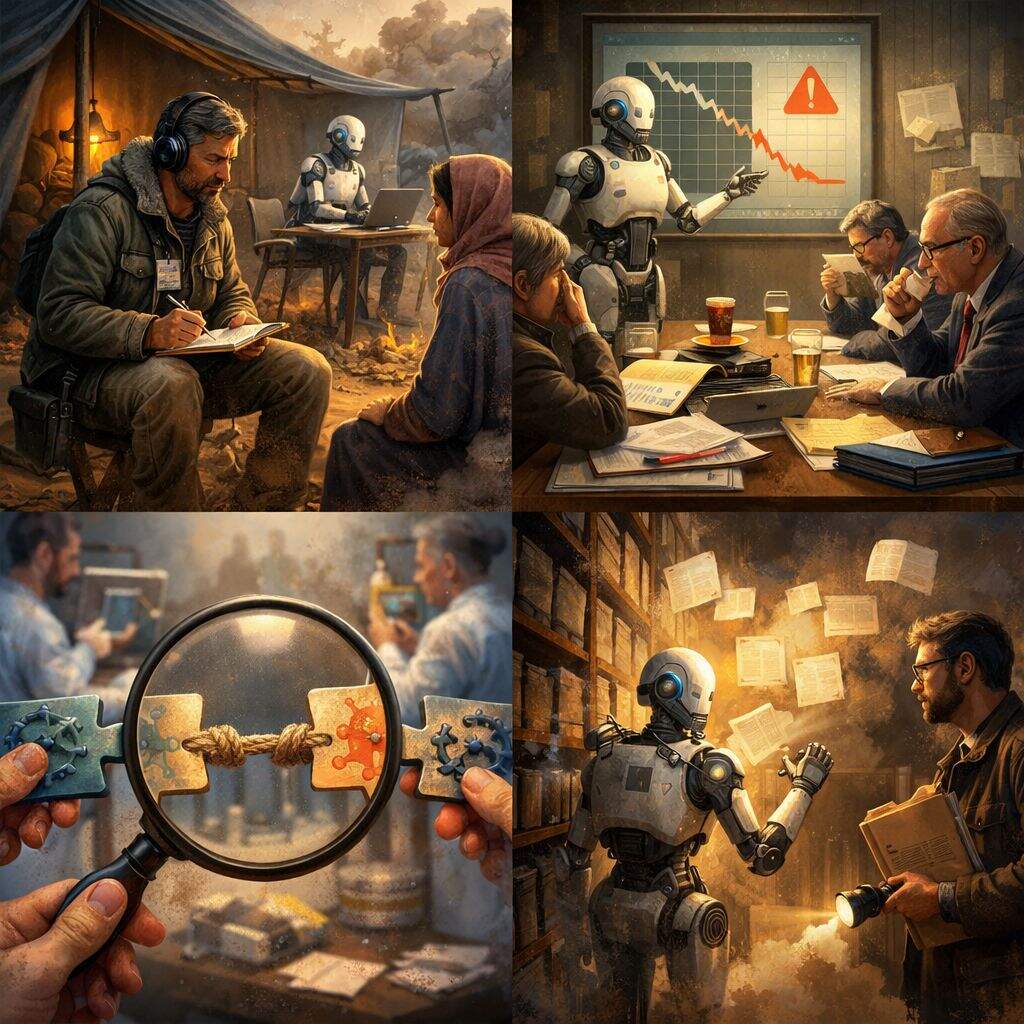

Every generation believes it has discovered the machine that will finally discipline human chaos. The printing press would enlighten. Radio would educate. Television would civilise. The internet would democratise. And now, with the serene optimism of people who have just attended a transformation workshop and returned with a tote bag full of frameworks, we are certain that artificial intelligence will organise the modern institution. It is, as always, a charming thought.
Unfortunately, the early evidence suggests that while machines are becoming more intelligent, the institutions within which they must operate remain magnificently human—full of habits, rituals, and minor vanities that would puzzle a reasonably observant house cat (in my case, a dog). And this matters (not the fact that I am a dog person, of course).
Because if one studies crises—corporate collapses, financial disasters, policy failures, technological breakdowns—one discovers a pattern so consistent that it begins to feel like a design feature. Almost every catastrophe begins quietly. For every single crisis, someone did not pick up the early signals. The problem, therefore, is not intelligence. It is attention. And more dangerously, the absence of curiosity.
Artificial intelligence can now detect patterns, summarise anomalies, and flag irregularities in seconds. It can tell you that something is wrong. But it cannot force an organisation to care because, in most cases, that decision must still travel. Through Legal, which will review the adjectives. Through Brand, which will consider whether the tone aligns with the brand promise. Through Compliance, which will gently enquire whether any verbs might create regulatory anxiety. Through senior leadership, which will wonder whether the entire matter aligns with the strategic narrative for the quarter. By the time the signal completes this ceremonial yatra, it has usually matured into a crisis large enough to merit a panel discussion.
Technology, in other words, moves like a cheetah. Institutions move like a committee attempting to remember where it left its spectacles. And signals, unfortunately, do not wait.
Outside the meeting room, another transformation is underway. For two decades, we believed the central problem of the digital age was access to information. Knowledge would be abundant. Barriers would fall. Everyone would know everything. This prophecy has been fulfilled with admirable thoroughness. We now have more information than any civilisation in history. What we have slightly less of is clarity about which parts of it are true, and even less patience to ask why any of it matters.

Artificial intelligence can generate words at extraordinary scale. Articles, summaries, opinions, reflections—it produces them all with a tone of calm authority that would make even the most confident columnist slightly nervous. Words, in other words, are becoming cheap. The internet is slowly turning into the intellectual equivalent of a Delhi wedding buffet where the paneer never runs out. The difficulty is not filling the plate with it. It is knowing which dish was cooked by a chef and which one emerged from a machine that was asked, with touching optimism, to ‘write something authoritative’.
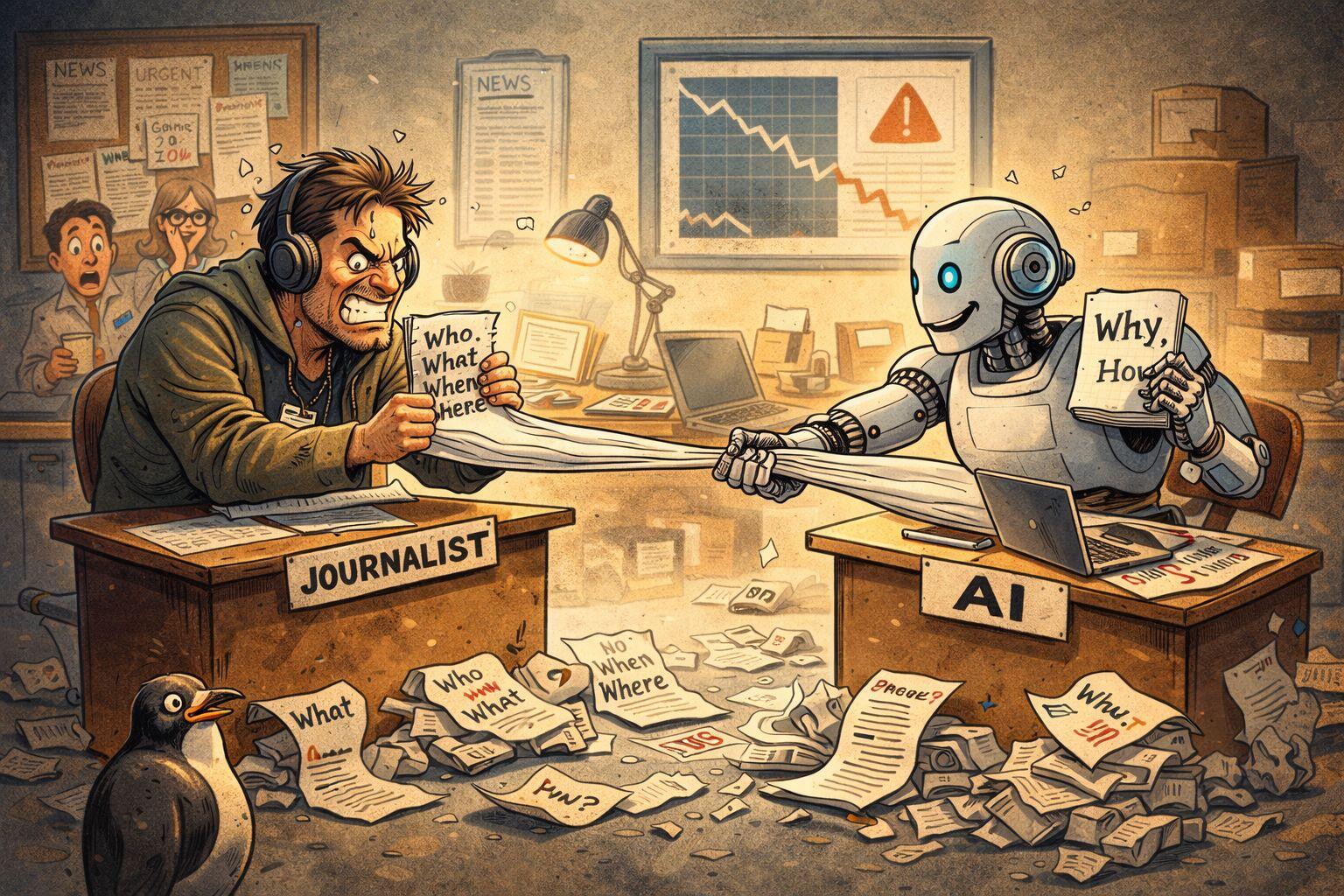
And this is precisely where journalism finds itself, somewhat sheepishly, rediscovering its original purpose. What machines produce with great efficiency is the answer to what. What happened. What was said. What the numbers are.
But the world does not run on ‘what’. It runs on why and how. Why did this happen at all? How did we get here? Who ignored the signal? Who benefited from the delay? What was said in the room when the spreadsheet was quietly closed? These are not questions that can be answered from a dataset. They must be reported.
What we are now calling “AI irreducible stories” is, in truth, simply journalism remembering its job. Stories that cannot be assembled from the safety of a browser tab, that require us to leave the building, to sit in uncomfortable positions, to wait, to listen, and to notice not just what is being said but what is avoided. Because the machine knows only what has already been written, but it does not notice hesitation, sense discomfort, or recognise that silence, in many rooms, is the loudest form of speech. A machine cannot, in any meaningful sense, answer why power moved the way it did, nor can it explain how systems failed while appearing to function perfectly. That work remains stubbornly human, and therefore, suddenly valuable.
Modern organisations, of course, remain very proud of their expertise. Every problem now has a specialist. Often several.
Each understands his fragment of the world with impressive depth and admirable confidence. What is occasionally missing is a sense that the fragments might, at some point, need to connect. One increasingly meets men greatly learned in parts and faintly bewildered in the whole. Specialisation has advanced to such refined levels that it occasionally feels as though medicine itself is approaching the inevitable moment when doctors will specialise in the right nostril. A second expert will manage the left, and a third will convene a panel to ensure cross-nostril alignment with the broader respiratory vision.
Artificial intelligence arrives into this ecosystem with the innocent ambition of synthesis. Journalism, if it is paying attention, must do the same. Because signals do not arrive labelled by department; they arrive in fragments, and someone must notice how the fragments form a story.
In such a world, the scarce resource is no longer information. It is verification. Anyone can produce a paragraph. Machines can produce millions. But to say, calmly and with evidence: here is the claim, the source, the proof—that requires reporting.
Truth, in other words, will behave like a luxury good. Everybody will have words, but only a few may have receipts. And those receipts will increasingly come from the field—from documents, conversations, observations that have not yet been absorbed into the great buffet of machine-readable text.
There is also a small, slightly uncomfortable irony at play. Modern AI systems learn from the commons—journalism, research, archives—what have you, in years of human effort placed into the public domain with the vague hope that it might improve collective understanding. But if journalism produces only what can be easily replicated, it begins to train the very systems that will replace it. It is a rather elegant tragedy. Like a chef meticulously documenting recipes for a kitchen that will soon no longer require him. Irreducible reporting interrupts this loop. It produces knowledge that does not yet exist in the system. It waters the commons rather than merely extracting from it.
Which brings us, finally, to the only question that matters. AI is not asking whether we can produce more content. It is perhaps asking more loudly whether we can produce anything that cannot be reduced. Whether journalism can move beyond the easy competence of answering what, and return to the harder discipline of asking why and how.
History suggests caution. But then history also gave us the necktie, annual appraisals, and the belief that the phrase “let us circle back” improves any civilisation into which it is introduced. So perhaps there is still hope, provided, of course, that someone is willing to leave the building and find out what is actually going on.
Disclaimer
Views expressed above are the author’s own.
END OF ARTICLE